RAÉL HADLEYREVEREND · AUTHOR · THINKER
Menu
← THE BOOKS
Religion, ego & transformation

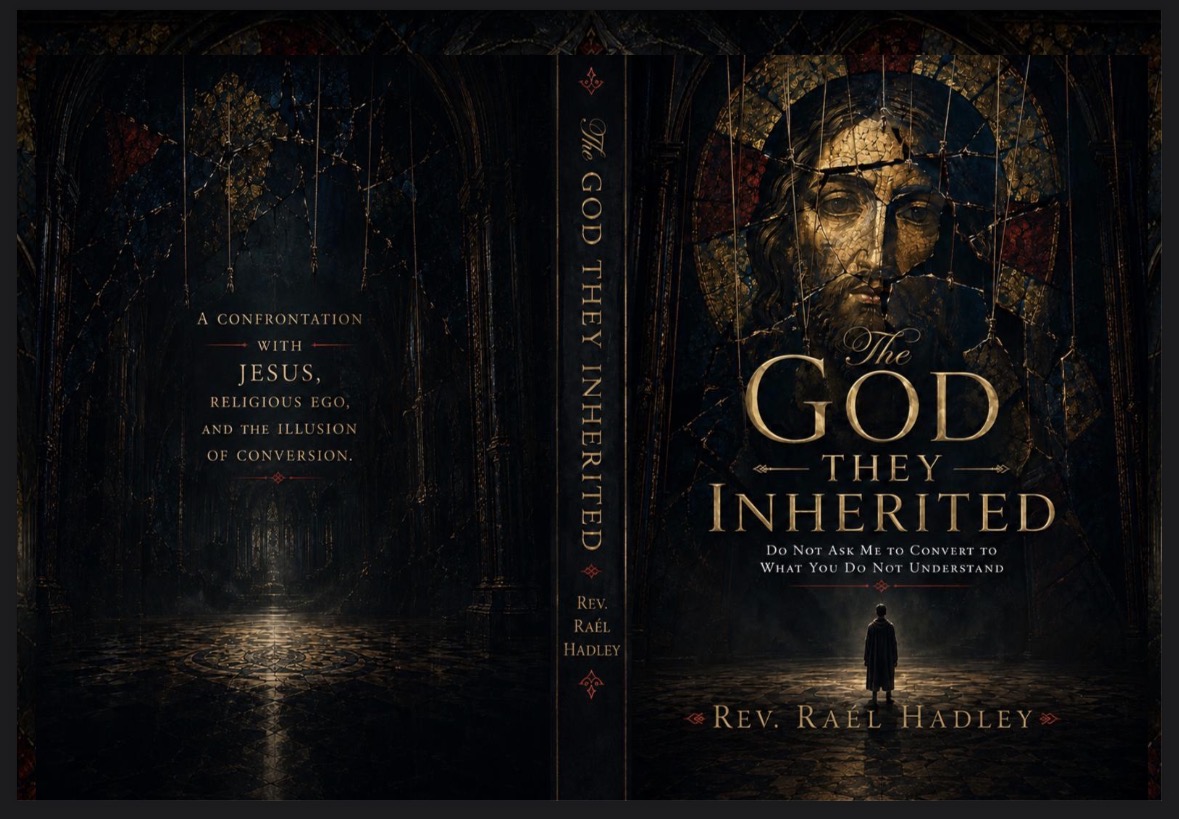
The God They Inherited

Do Not Ask Me to Convert to What You Do Not Understand

What happens when inherited interpretations acquire authority over other people?

ABOUT THE BOOK

The psychological and religious application

A confrontation with spiritual pressure, inherited images of God, and the ego that learns to speak in sacred language. The book turns religious critique into a demand for self-examination, asking what faith actually makes of the person who professes it.

Read the opening

Why This Book Had to Be Written Some books are written because an author has an idea. This book was written because I had a wound. Not the kind of wound that disappears because time passes. Not the kind of wound that becomes smaller because people tell you to move on. Not the kind of wound that can be prayed away by the same kind of voices that helped create it. This wound came from watching people speak about God with certainty while carrying very little understanding. It came from hearing people talk about salvation as if it gave them permission to look down on the souls of others. It came from seeing Jesus used as a weapon by people who seemed less interested in becoming like him than in making others bow to the version of him they inherited. It came from family. It came from pressure. It came from watching people I love be treated as spiritually incomplete by people who had never deeply examined the faith they were using to judge them. That is where this book begins. Not in hatred. Not in rebellion for the sake of rebellion. Not in some shallow desire to attack Christianity. This book begins with a question: Do you actually understand what you are asking another soul to become?

The God They Inherited, manuscript p. 5. Transcribed from the supplied manuscript; line breaks normalized.

IN THIS BOOK

Concepts & arguments

Major argument

Convert Into What?

An invitation to conversion must clarify what kind of transformation it asks for. Adopting a label cannot stand in for understanding.

Manuscript p. 29
Major argument

Inherited God vs. Encountered God

The image of God absorbed through family, fear, and community is not identical to the mystery it claims to describe. Inheritance must be examined rather than merely repeated.

Manuscript p. 46
Major argument

The Wound of Spiritual Pressure

Concern for another person becomes domination when it uses fear or spiritual authority to override their agency. A frightened yes is not the same as freely chosen faith.

Manuscript p. 67
Major argument

Scripture as Mirror Before Weapon

Sacred texts should examine the reader before being used to judge others. Historical context and self-examination matter wherever scripture carries moral authority.

Manuscript p. 96
Major argument

Heaven, Hell, and Fear

Teachings about ultimate consequences can become instruments of control. The book questions inherited interpretations and the use of terror as evidence of truth.

Manuscript p. 128
Major argument

The Kingdom Was Never Just in the Sky

The language of the kingdom is explored as a demand on the present life, not merely a promise deferred beyond it.

Manuscript p. 158
Major argument

Sin, Salvation, and Transformation

Sin and salvation are examined through distortion, disconnection, and transformation. The inquiry asks what religious language means for the life being lived.

Manuscript p. 183
Major argument

Which Jesus?

Cultural images of Jesus can reflect the priorities of those who inherit them. Following a teacher requires examining the image through which that teacher is understood.

Manuscript p. 215
Major argument

Jesus Beyond Religious Ownership

Loud identification does not confer ownership of Jesus or exclusive authority over others. The teachings remain a challenge to the people who claim them.

Manuscript p. 244
Major argument

Profession vs. Practice

Calling Jesus Lord while disregarding his example reveals a gap between religious identification and lived conduct.

Manuscript p. 272
Major argument

The Son of God and the Children of God

The book examines language of divine relationship and belonging, asking how theological claims shape the dignity extended to other people.

Manuscript p. 300
Major argument

Following Jesus and Examining the Self

A demand that another person follow Jesus should be accompanied by the speaker’s willingness to be confronted by the same teachings.

Manuscript p. 324
Major argument

Conversion Without Understanding Is Recruitment

Changing religious membership is not identical to spiritual transformation. Understanding and a changed life are stronger criteria than recruitment into a group.

Manuscript p. 345
Major argument

Selective Obedience

Choosing teachings that confirm one’s authority while neglecting those that demand humility allows the ego to remain protected by religious language.

Manuscript p. 369
Major argument

Faith vs. Fear

Fear may produce compliance without producing love or moral transformation. The book asks what remains of faith when intimidation is removed.

Manuscript p. 397
Named concept

The Sanctified Ego

The self can learn to hide its desire for superiority, control, and validation behind sacred language. Religion can become a costume for an ego that has not changed.

Manuscript p. 419
Major argument

What Real Faith Requires

Honest faith requires examination, humility, and a willingness to change. Its depth is tested in conduct and responsibility.

Manuscript p. 444
Major argument

God Beyond the Name

A human name or inherited image cannot be assumed to exhaust divine reality. Language may point beyond itself without possessing what it names.

Manuscript p. 464
Major argument

The Mirror

Religious critique must turn back toward the critic. Self-examination asks whether the beliefs one defends have made one more truthful, loving, and humble.

Manuscript p. 486
Major argument

After the Inherited God Falls

The collapse of an inherited image can open a more honest spiritual inquiry. The loss of superiority need not mean the loss of reverence.

Manuscript p. 507